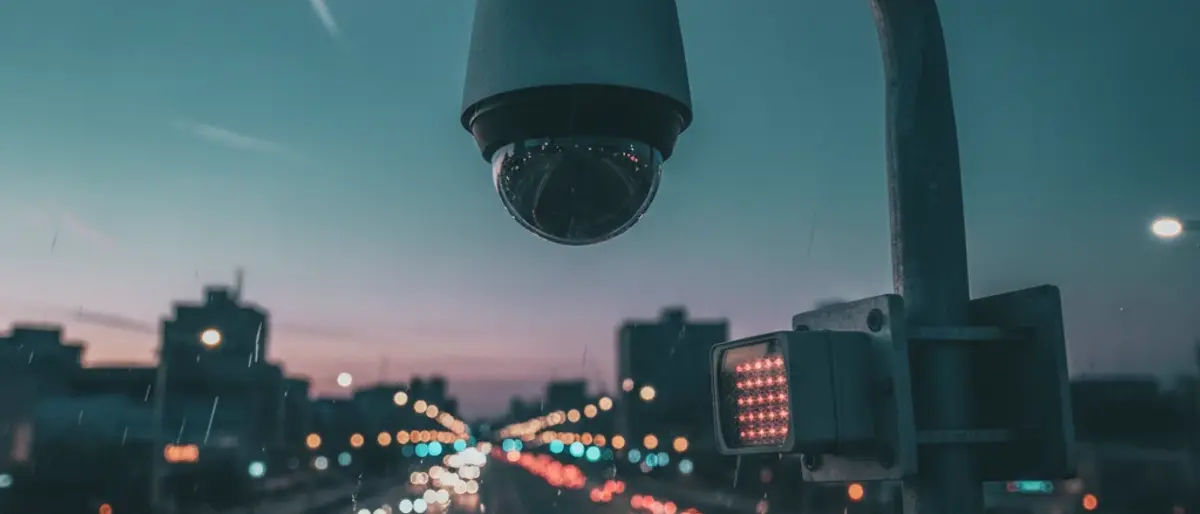
Betting on Traffic Cameras: what the detection model sees
When you bet on traffic cameras, the camera is not the judge; the detection model is. A zone is drawn over the live frame, a computer vision model tracks moving objects, and each object that crosses the zone boundary is added to the count that settles your bet. That is why viewpoint, lane count and lighting shape the numbers far more than any feeling about how busy a street looks.
 Zone on the framea rectangle drawn over the live picture, fixed per feed
 Object trackingeach vehicle gets an identity and is followed across frames
 Boundary crossingone crossing of the zone edge is one point; presence inside adds nothing
 ≈55 s windowthe count freezes automatically when the round clock ends
 SHA-256 committhe round is committed before betting closes, seed revealed after
 7 feedsTokyo, Lyon, Sydney, London, Paris, Bucharest, Bangkok
The camera shows, the model decides
Two things get mixed up on every forum thread about betting on live traffic cameras, and separating them explains most of the complaints. The camera produces a picture: a fixed lens on a pole, a frame every few milliseconds, broadcast from the studio's facility around the clock. The model produces a number. It takes those frames, finds moving objects, assigns each one an identity, follows it, and adds one to the count when the object's path crosses the boundary of the detection zone. The picture is for you. The number is for settlement.
That split is why "I can see more cars than the counter shows" is not a dispute you can win by pointing at the screen. The counter is not a tally of cars in the frame. It is a tally of boundary crossings inside a rectangle that covers only part of the frame, and a vehicle sitting in the far lane, parked at the kerb or still rolling towards the zone is visible to you and irrelevant to the model. The question to ask is not "how many cars do I see" but "where does the zone edge sit and who has crossed it".
The practical consequence is that a feed's count is a property of the camera-plus-model pair, not of the street. Move the zone ten metres, change the lens angle, and the same road produces a different baseline. The home page covers the format; this page covers the instrument.
One object, one identity. A naive counter would add one for every frame a vehicle spends in the zone. A tracker counts each identity once, at the crossing, which is why queues at a red light do not race the counter upward.
Zone geometry: where the line sits
The biggest lever on a feed's numbers is not the city, the hour or the weather. It is the rectangle: where the zone is drawn and how much of the road it spans decides how many crossings a stream of traffic can produce in a 55-second window, and no two feeds draw it the same way.
Three placements show the range. A narrow zone at the edge of the frame catches only the lanes that pass through it; vehicles in the other lanes cross the picture and never cross the line. A wide zone across all lanes makes every lane a counting lane, so the same street yields a number several times higher. A zone beyond a stop line behaves differently again: on red, nothing crosses; on green, a platoon crosses in a burst and the count jumps in steps.
This is why the same visible flow on two feeds gives systematically different numbers, and why the operator sets a separate line per feed. "Over 34" on a wide Tokyo zone and "Over 9" on a narrow night-time Lyon zone are the same market against different instruments. The baseline is a property of the feed, camera angle plus zone, not of the city.
Lane count is the second lever: each lane through the zone is a separate channel of crossings. The cars passing page covers why a jam can produce fewer crossings than free flow; here the point is simpler: before you read a line, look at where the rectangle is.
Seven feeds, seven instruments. Pick a city: the clock is local time, and the frame is our own illustration of that feed.
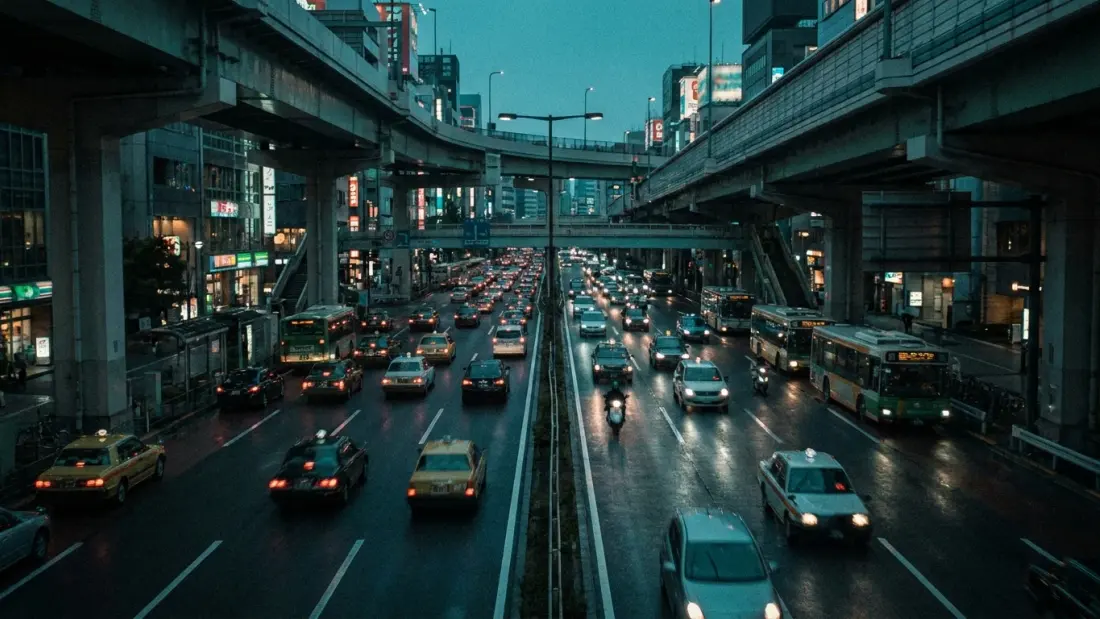 REC · CAM 01
TOKYO --:--:--
Detection zone
scooters and taxis in the mix
Daytime feed
REC · CAM 01
TOKYO --:--:--
Detection zone
scooters and taxis in the mix
Daytime feed
Look at the rectangle before the line
Open a feed, find the zone edge on the frame, and watch where the counter actually ticks. Rush Hour has run in the Stake, Shuffle and Roobet lobbies since 18 February 2026.
Occlusion: when vehicles hide each other
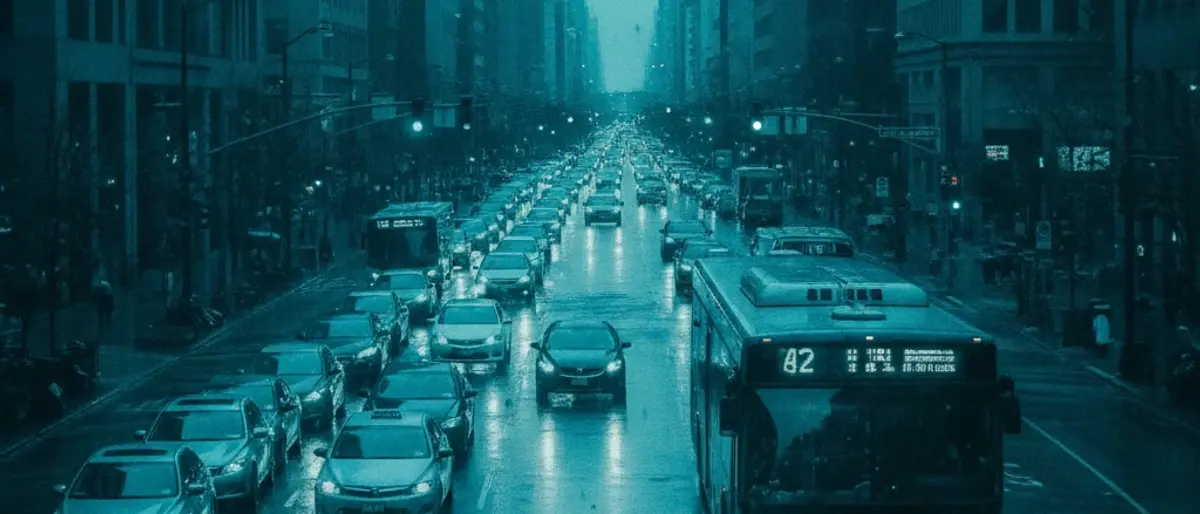
Every camera count has one failure mode that processing never fully removes: occlusion, one object hiding another. A double-decker in the near lane covers a hatchback in the far lane for a second or two. A dense queue merges into one silhouette. A scooter weaving between two vans blinks in and out of view. Each time, the tracker has to decide whether it sees one object or several, and whether the object that emerged is the one that went in.
Viewpoint decides how often this happens. A side-on camera, looking across the lanes, stacks them behind each other in the image, so anything in the near lane can block anything in the far lane. A head-on or elevated camera separates the lanes left to right, and overlaps only occur within a lane. Both are a fixed property of the feed, like the zone rectangle.
The honest part: how much occlusion moves the final count, and whether a merged queue is split back into vehicles, the studio does not publish per feed. We will not invent a percentage. What the published design does say is that counting happens at the boundary, so a vehicle hidden mid-zone but visible at the edge can still be counted; one hidden exactly at the crossing cannot. That is a structural statement, not a measured one.
Night, rain and headlight glare
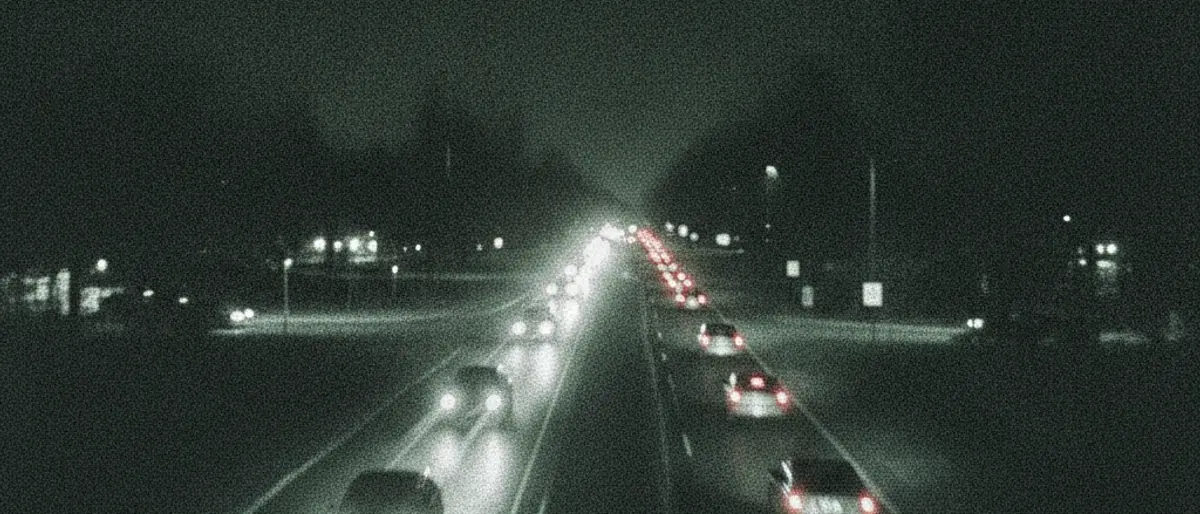
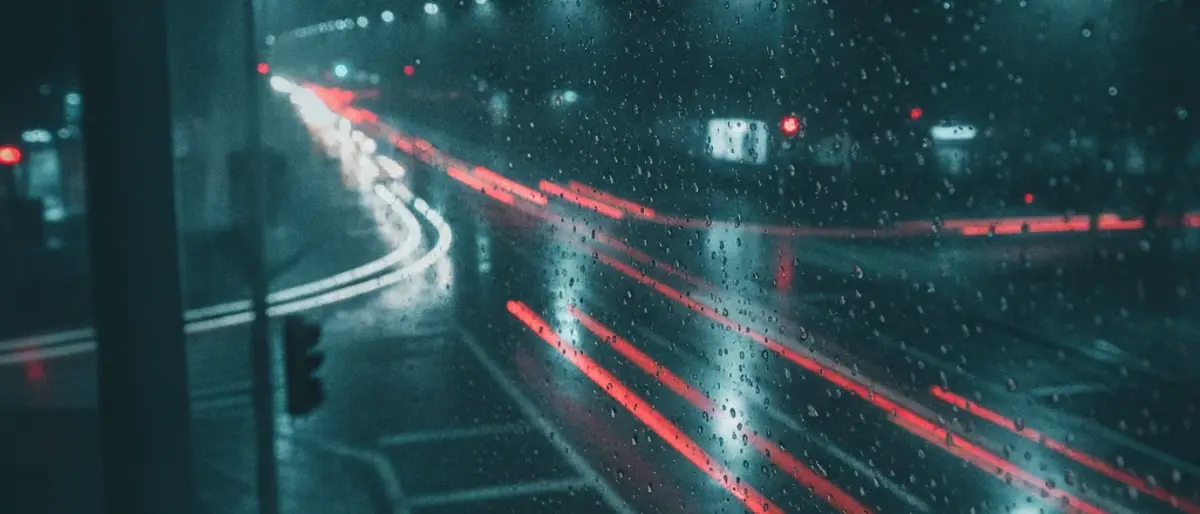
A camera that counts reliably at noon is a different instrument at midnight. In the dark the model loses the thing it recognises best, the outline of a vehicle, and gets a pair of headlights instead. Headlight glare blooms across the sensor and can swallow the car behind it. Rain adds drops on the lens that blur edges, and wet asphalt turns the road into a mirror, so every light appears twice: once on the vehicle and once in the reflection below it. Fog and low sun do similar things for different reasons.
The fixed camera does not change, so none of this is a new zone or a new lane count. It is the same rectangle with a worse picture, and the tracker has to keep identities stable through a noisier feed. The studio does not publish how detection quality varies by hour or weather, and we do not estimate it.
The second point is easy to miss: at night, the traffic itself changes, not just the picture. Fewer vehicles, different mix, longer gaps, more buses and taxis relative to commuters. A night feed is, for betting purposes, a different feed with a lower line and its own spread. Comparing the scatter of 3 a.m. results with the scatter of 5 p.m. results on the same camera tells you nothing about the model; it tells you the city went to sleep. That is one of the reasons stakes and limits argues for sizing on the feed in front of you, not on a remembered one.
What you can audit and what you cannot
Betting on traffic cameras is unusually transparent about the event and opaque about the instrument. On the open side: the video is live, the count is shown on the frame as it happens, and before betting closes the studio publishes a SHA-256 commitment to the round. After settlement the seed is revealed, the seeds form a pre-committed hash chain, the specification is public at docs.155.io, there is an open verifier, and any round can be looked up by its ID. Recompute the hash, compare it with what was published, and you have proved that the round you were shown is the round that was settled.
On the closed side: the detection model itself. Its architecture, its thresholds, how it handles a merged queue and how each of the seven feeds is configured are not published. You cannot run the footage through the studio's model and check that 27 was the right answer; you can only check that 27 was the answer committed before the close.
The plain conclusion: verifiability of the round is not verifiability of the count. The commitment guarantees that nobody changed the number after you bet, not that a human with a clicker would have reached the same one; the 90.00–92.16 % band already prices in the instrument. The car betting game page shows the settlement screen in the product.
Fairness receipt
- Round ID
- RH-000000
- Commit (before close)
- …
- Seed (after settlement)
- —
- Result
- —
Demo: this page computes a real SHA-256 of seed + count in your browser. The studio's chain uses the same principle with its own format.
Check a round by its ID
Open a feed, note the round ID, and compare the committed hash with the revealed seed after settlement. It takes less time than the round itself.
FAQ
How does betting on traffic cameras work?
A detection zone is placed over the live frame and a computer vision model counts every tracked object that crosses its boundary during the round. Your bet settles on that count, not on what you personally see.
Why does the counter show fewer cars than I see?
Only crossings of the zone boundary are added. Vehicles outside the zone, or still inside it, are visible but not counted yet.
What happens when a bus hides a car?
Overlapping objects are the known weak point of any camera count, and side-on viewpoints make it more likely than head-on ones. The studio does not publish how often it occurs, so no figure should be assumed.
Does night or rain change the numbers?
Both change the image and the traffic itself. A night feed is a different feed in practice, which is why counts from different hours should not be compared directly.
Can I verify a camera round?
You can verify the round: its outcome is committed as a SHA-256 hash before betting closes and the seed is published at settlement. The detection model itself is not open to inspection.
Visible is not the same as easy
The camera makes the event visible, not easy. You can watch every vehicle that decides your bet, find the rectangle and recompute the commitment after the close. What you cannot do is see through the model: where it loses a car behind a bus, how it reads headlights in rain. Those are private, and the 90.00–92.16 % band already accounts for them.
Where the feed is open
 Rush Hour since 18 Feb 2026
 Rush Hour since 18 Feb 2026
 Rush Hour since 18 Feb 2026 · Snow Run exclusive 31 Mar 2026
Availability differs by operator and country. We do not rate operators and publish no bonus offers. Checked 21 August 2026.
Risk note. Betting on traffic is entertainment, not income. The published return band of 90.00–92.16 % means that over many rounds the operator keeps 8–10 % of everything staked, and with about 65 rounds an hour those rounds add up fast. Set a deposit and a time limit before you open a feed, never chase a count, and read our responsible gambling page. Help is free at BeGambleAware.org.