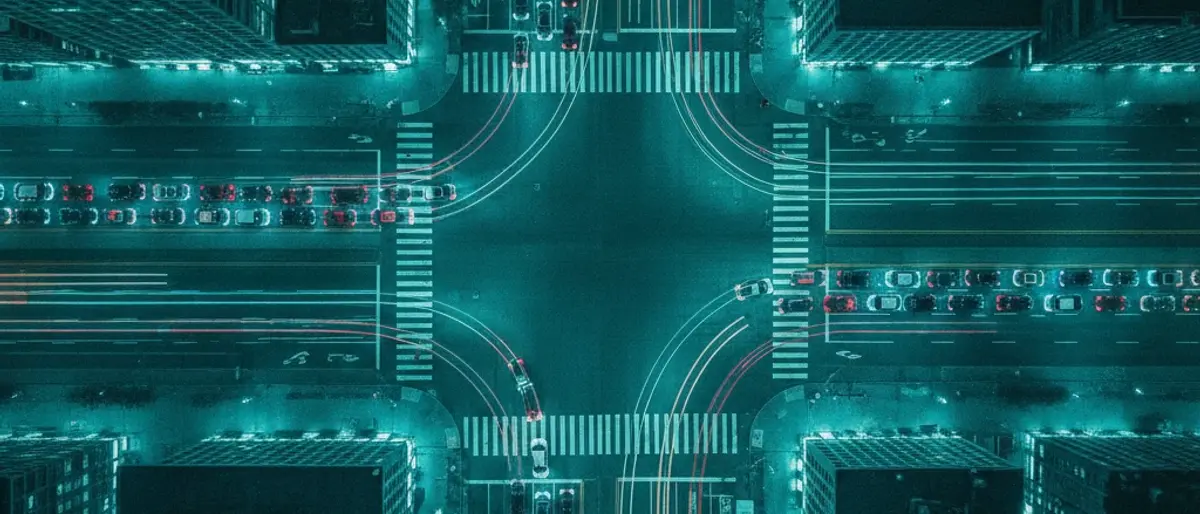
Bet on Cars Passing: counting vehicles through a live zone
Betting on cars passing means backing a number: how many vehicles cross a marked zone on a live road camera before the round closes, which takes about 55 seconds. The format is Rush Hour, released by 155 Media Studios on 28 January 2026, and you can take Under, Over, Range or Exact on that count. A vehicle counts when it crosses the boundary of the detection zone, not when it appears on screen, and the studio publishes the return band at 90.00–92.16 %.
 A numberthe object of the bet is the count of vehicles, nothing else
 The boundarya vehicle counts when it crosses the edge of the detection zone
 ≈55 sone round window; about 65 rounds every hour
 90.00–92.16 %return band published by 155 Media Studios
One vehicle, one crossing
Everything on this page follows from a single rule: the count registers a crossing of the zone boundary, not the presence of a vehicle in the frame. The detection zone is a rectangle drawn on the camera picture. A computer vision model tracks each object and adds one to the count at the moment its path passes over the edge of that rectangle. A car that is visible for the whole round but never touches the boundary is worth nothing. A car that enters the zone at the last second is worth exactly one.
This is why a vehicle stopped inside the zone at a red light does not move the number. It sat there, it was filmed, it was tracked, but it did not cross a line, so the counter stays where it was. Only when the signal changes and the queue starts rolling across the boundary does the count begin to climb, one crossing per vehicle.
The consequence almost nobody explains: a dense jam can produce a lower count than free-flowing traffic. A jam is a lot of vehicles moving very little, and a count is about movement across a line. A street where twenty cars roll through the zone one after another beats a street where forty cars stand bumper to bumper waiting for green. Crowded footage looks like a high number and often settles as a low one.
Four markets on that count. Under, Over, Range and Exact are the only things you can back. There is no market on the colour of a car, on a specific lane or on whether the light changes.
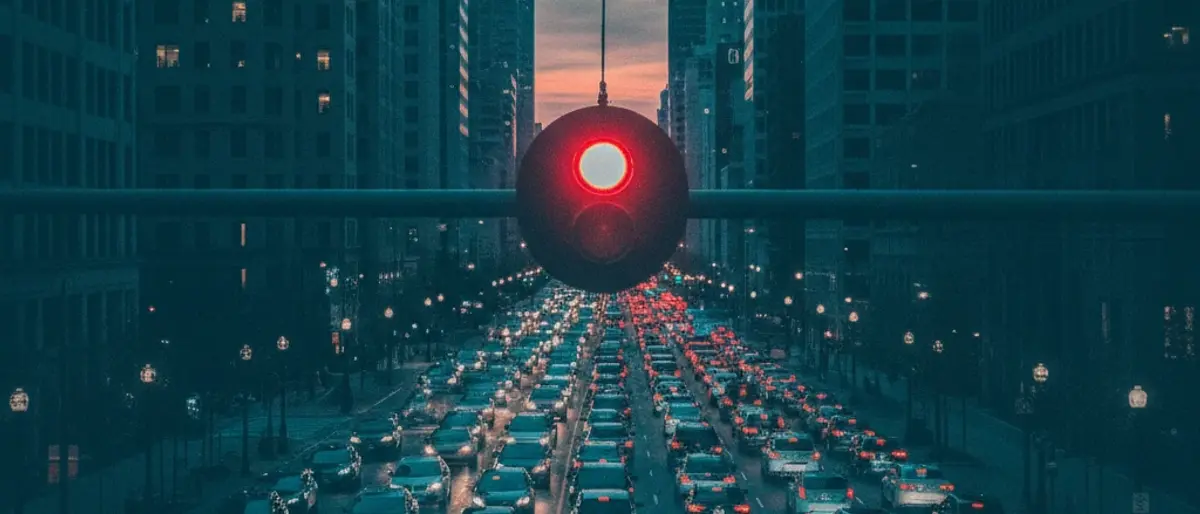
Illustrative pair: same zone, same 55 seconds, opposite result. The numbers are an example of the mechanism, not a record of any feed.

What counts as a vehicle
The tracker does not rank vehicles by size. A hatchback, a double-decker bus, a pickup and a moped are each one object, and each one adds one when it crosses the boundary. That flattens the picture in a useful way: when you watch a feed, you count shapes moving across a line, not tonnage. A tuk-tuk in Bangkok and a black cab in London carry the same weight in the result.
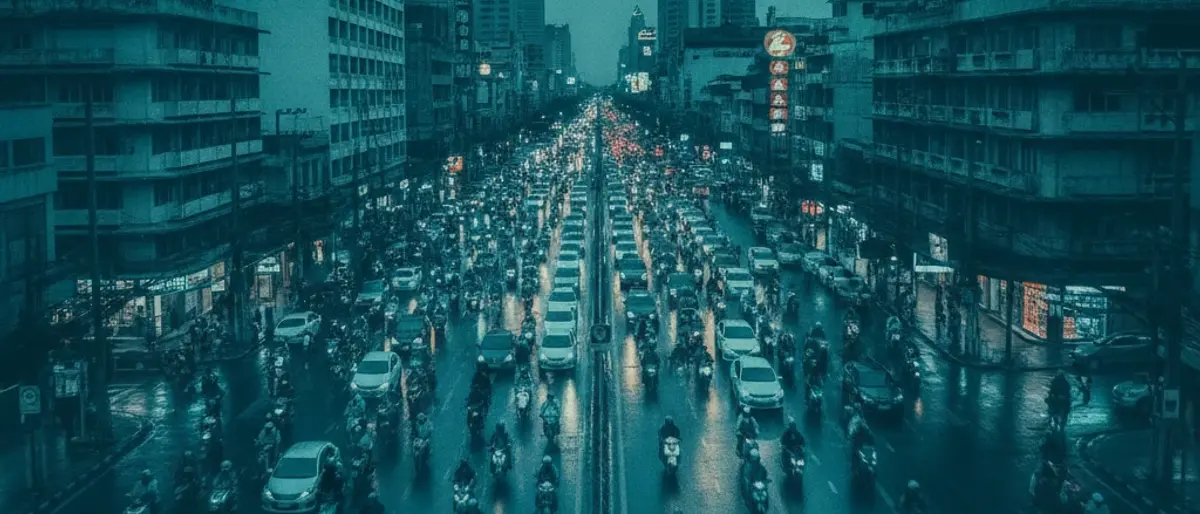
Composition, however, changes the rhythm of the count. Bangkok and Paris push a large share of two-wheelers through their zones: motorbikes and scooters filter between lanes, move off first at green and cross the line in bursts of several at once. London's stream leans on buses and taxis, which are large, spaced and slow to clear a boundary. Tokyo mixes taxis into everything. The total is still one per crossing, but a two-wheeler city fills its count in lumps while a bus city fills it in a steady trickle.
Whether bicycles, mopeds or pedestrians are inside the detection configuration is set per feed, and the game states it in the lobby for the camera you are watching. Where the lobby does not say, neither do we: the game does not publish this per feed, and we do not guess a composition for a city on your behalf. The safe reading is to check the feed's own note before you assume "cars only" and then be surprised by a line that looks high.
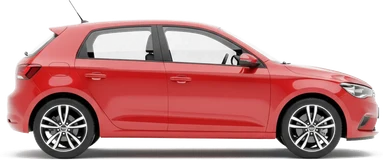 +1hatchback
 +1van
+1van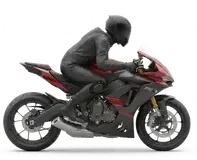 +1motorbike
 +1bicycle, if the feed counts it
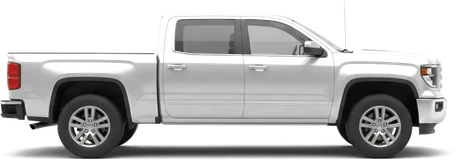 +1pickup
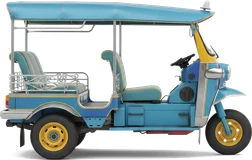 +1tuk-tuk
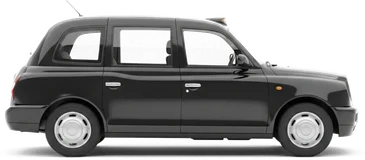 +1black cab
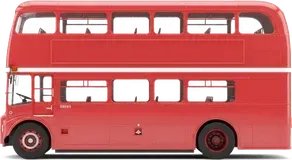 +1double-decker
Each shape is one crossing and one point. What the model is configured to detect is stated per feed in the lobby; where it is not stated, the game does not publish it.
Intersections and open road
Betting on cars through an intersection and betting on an open stretch use the same rule and produce different shapes of result. At a junction the flow is portioned. The signal cycle holds vehicles, then releases them, so the zone sees a platoon of crossings followed by a gap. A 55-second window can swallow one full release, parts of two, or a long red with a trickle from a side street, and the count jumps accordingly.
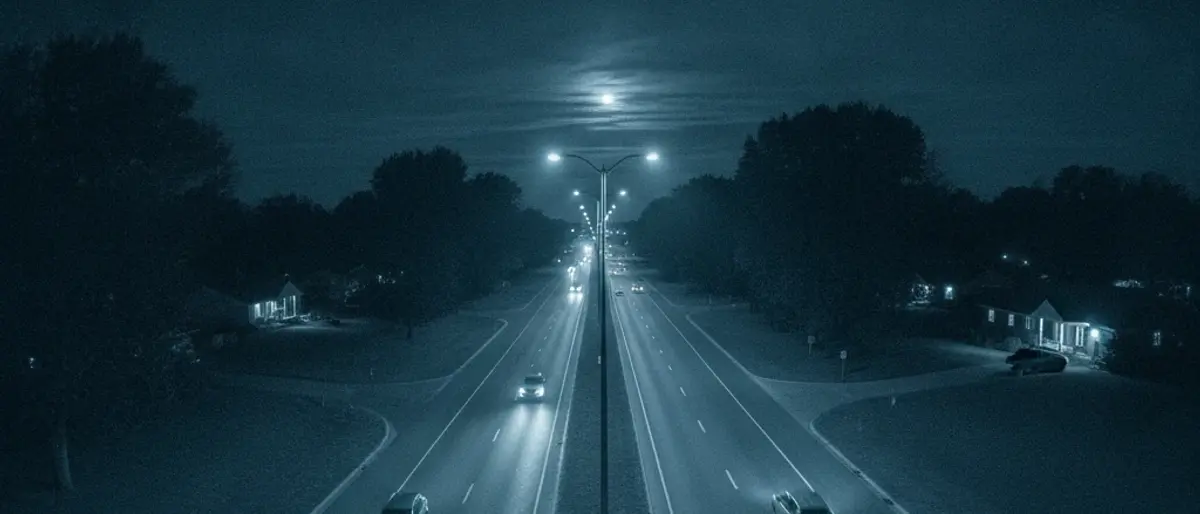
On an open section there is no gate. Vehicles arrive roughly as they left the previous junction, spread out by distance and speed, and the zone registers a steadier drip of crossings. The total over a round is less lumpy, and two consecutive rounds on the same open road tend to look more alike than two consecutive rounds at a signalised crossing. The junction's number is not higher or lower on average; it is more spread out around its own middle.
The signal cycle therefore decides when vehicles cross, and the round clock decides which part of that cycle you are betting on. Neither is visible in the odds, because the operator prices the feed, not the phase. Timing a bet to the light is a subject for our betting on traffic cameras page, where the zone geometry and the tracker's behaviour at a stop line are laid out in detail; here it is enough to know that the shape of the distribution is the junction's doing.
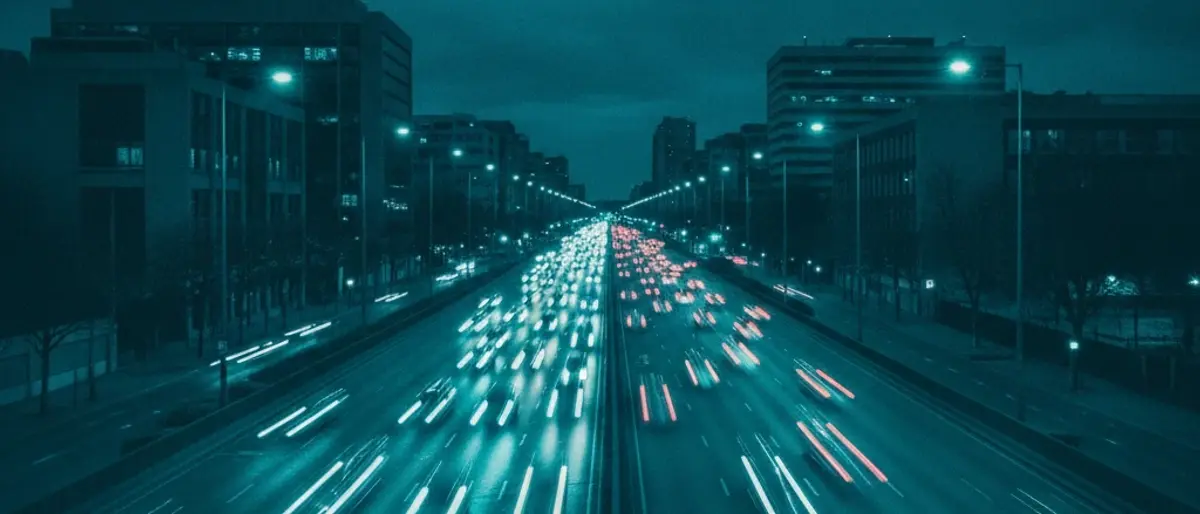
Typical counts and how far they swing
Every feed has a baseline, the level its counts hover around at a given hour, and a spread, how far individual rounds stray from it. Both belong to the feed alone. They come from the width of the road, the number of lanes inside the zone, the signal timing, the time of day in that city and the mix of vehicles. A riverside boulevard in Lyon at night and a multi-lane road in Tokyo in the afternoon are two different distributions, and the operator sets a separate line for each.
We do not print "typical" numbers for any feed. They have not been measured by us across enough rounds to be honest, the studio does not publish them per feed, and a figure invented for a table would be worse than none. What you can see for yourself, in a few minutes of watching, is the order of magnitude of a feed and how wildly consecutive rounds differ from it.
That is also why observations do not travel. Ten rounds on Sydney in the morning tell you about Sydney in the morning. They say nothing about Bucharest an hour later, and very little about Sydney after the evening peak. When the lobby rotates you to another camera, the baseline, the spread and the line all change together, and your notes start from zero.
Seven feeds, seven baselines. Tokyo, Lyon, Sydney, London, Paris, Bucharest and Bangkok each carry their own level and swing, which is the reason the same market shows a different line on every camera.
How the four markets pay
Under and Over work like a total in sports. The operator sets a line for the feed, for example 34 on a busy afternoon camera, and you back the count finishing below or above it. Each side prices close to even money, and the margin is taken out of both prices, which is where the 90.00–92.16 % band comes from.
Range asks for the count to land in a band around the line, a few numbers wide. It hits less often than one side of a total, because the band covers less of the distribution than a whole half, and it pays correspondingly more. Exact is one number. It carries the highest payout on the board and the lowest frequency by a wide margin.
The common mistake is treating Exact as a cheap lottery ticket. One Exact at a small stake looks harmless; the problem is the clock. At about 55 seconds a round, roughly 65 rounds pass in an hour, and an hour of "one quick Exact per round" is 65 bets at the lowest hit rate on the menu. The arithmetic of that, and the limit tools that keep it in check, are on our stakes and limits page.
Lines are set per feed and per round by the operator; the payouts below are illustrative at a 91 % return, in the middle of the published band. For the wider Rush Hour line-up and its neighbouring titles see car betting game.
Bars are illustrative hit rates; payouts derived at a 91 % return. Real lines and prices are set by the operator for each round and feed.
See a live round for yourself
Rush Hour has been in the Stake, Shuffle and Roobet lobbies since 18 February 2026. Watch a count settle and read the line before you stake anything.
Why "how many cars" cannot be guessed
People arrive at this page looking for a way to know the number. The straight answer is that a real street is unpredictable without being exploitable. Traffic has structure: peaks, cycles, platoons. But structure is not a forecast of a single 55-second window, and the operator prices the feed with that structure already in the line. If afternoons run high, the line is set high. Observing the feed tells you why the count swings; it does not move you ahead of the price.
There is a second, quieter reason. The return band of 90.00–92.16 % is a property of the markets, not of your bets. Spreading stakes across Under and Range, doubling after a miss, alternating feeds or waiting for a "good" cycle rearranges which rounds you lose on. It does not change the share of everything staked that the house keeps over time. Variance can be moved around; the margin cannot.
What the format offers is not an edge but visibility. You watch the entire event that decides the bet, from the first car to the final second, and the round's commitment hash was published before betting closed, so the number you saw is the number that settled. That is a fair deal at a known price, which is more than most products of this kind say out loud.
Rounds run 24/7. With seven cities in different time zones there is always a feed with traffic, and about 65 rounds pass every hour. The clock, not the count, is what empties a balance.
FAQ
Can you bet on how many cars will pass?
Yes. That is exactly what Rush Hour settles: you back the number of vehicles crossing a detection zone on a live camera within a round of roughly 55 seconds, using Under, Over, Range or Exact.
When does a car actually count?
When it crosses the boundary of the detection zone. Sitting inside the zone at a red light adds nothing to the count until the vehicle moves across the line.
Does betting on cars through an intersection work differently?
The mechanic is identical, but the pattern is not. Signal phases release traffic in batches, so counts at a junction arrive unevenly compared with a free-flowing stretch.
Do motorbikes and bicycles count?
Detection is configured per feed and traffic composition varies widely between cities. Check what the game states for the camera you are watching instead of assuming cars only.
Is there a way to predict the count?
No. Watching a feed explains how much counts swing, but the line moves with the feed, and the published return band of 90.00-92.16 % applies to every round regardless of how you stake.
Which market pays best?
Exact, because it lands least often. Under and Over price closest to even money, and Range sits between the two.
Who betting on cars passing is for
See a live round for yourself
Rush Hour has run in the Stake, Shuffle and Roobet lobbies since 18 February 2026. See a live count before you decide.
Where the feed is open
Rush Hour reached Stake, Shuffle and Roobet on 18 February 2026, distributed through Hub88, which has been the studio's aggregation partner for the title since 26 February 2026. Betika has carried the 155 portfolio in Uganda and Kenya since 26 August 2025. Full list and notes on our operators page.

 Rush Hour since 18 Feb 2026
 Rush Hour since 18 Feb 2026
 Rush Hour since 18 Feb 2026 · Snow Run exclusive 31 Mar 2026
Availability differs by operator and country. We do not rate operators and publish no bonus offers. Checked 21 August 2026.
Risk note. Betting on traffic is entertainment, not income. The published return band of 90.00–92.16 % means that over many rounds the operator keeps 8–10 % of everything staked, and with about 65 rounds an hour those rounds add up fast. Set a deposit and a time limit before you open a feed, never chase a count, and read our responsible gambling page. Help is free at BeGambleAware.org.